
Gloucester County City Directory Collections
Gloucester County historical directories are a shelf of partial runs, not a single continuous county list. The strongest local starting point is the Gloucester County Historical Society in Woodbury, whose library describes printed directories, telephone books, family files, church and cemetery material, newspapers, probate material, and maps. Its listings should be checked by title and year before a visit. Some volumes describe a town, some cover several counties, and some are available only as reels or cataloged holdings at partner institutions.
| Collection | Years | Where held | How to use it |
|---|---|---|---|
| Salem and Gloucester Directory | 1875 | GCHS, Reel 45 | Inhabitants of Woodbury, Swedesboro, Woodstown, and other named places |
| Boyd's Directory of Salem and Gloucester Counties | 1897-98 through 1903-04 | GCHS Salem Segment III and IV reels | Woodbury and Salem City coverage, subject to each edition |
| Farm Journal Directory of Gloucester County | 1913 | State-library and partner holding catalogs | County-level name and place lead |
| Local city and telephone directories | 1920s-1950s, selected holdings | GCHS and repository catalogs | Verify the title, town, and reel before relying on it |
There are gaps in the shelf. The research identifies selected editions and repository leads, not an unbroken annual sequence or a universal digitized run. A missing name may reflect an unlisted household, a different town edition, an incomplete reel, or a gap in publication. Record the edition's scope before treating absence as evidence.
Gloucester County Directories at GCHS
The Historical Society is useful because a directory search can widen into newspapers, family files, cemetery material, maps, and local history without leaving the repository. GCHS lists Tuesday evening hours, Wednesday through Friday afternoon hours, and a third-weekend opening, with a listed non-member admission charge. Hours and access terms can change, so confirm them with GCHS before traveling. The Society also describes original county material from 1686 into the twentieth century, including deeds, court files, naturalizations, and private property surveys.
The GCHS library page shows the local collection used for this Gloucester County directory research.
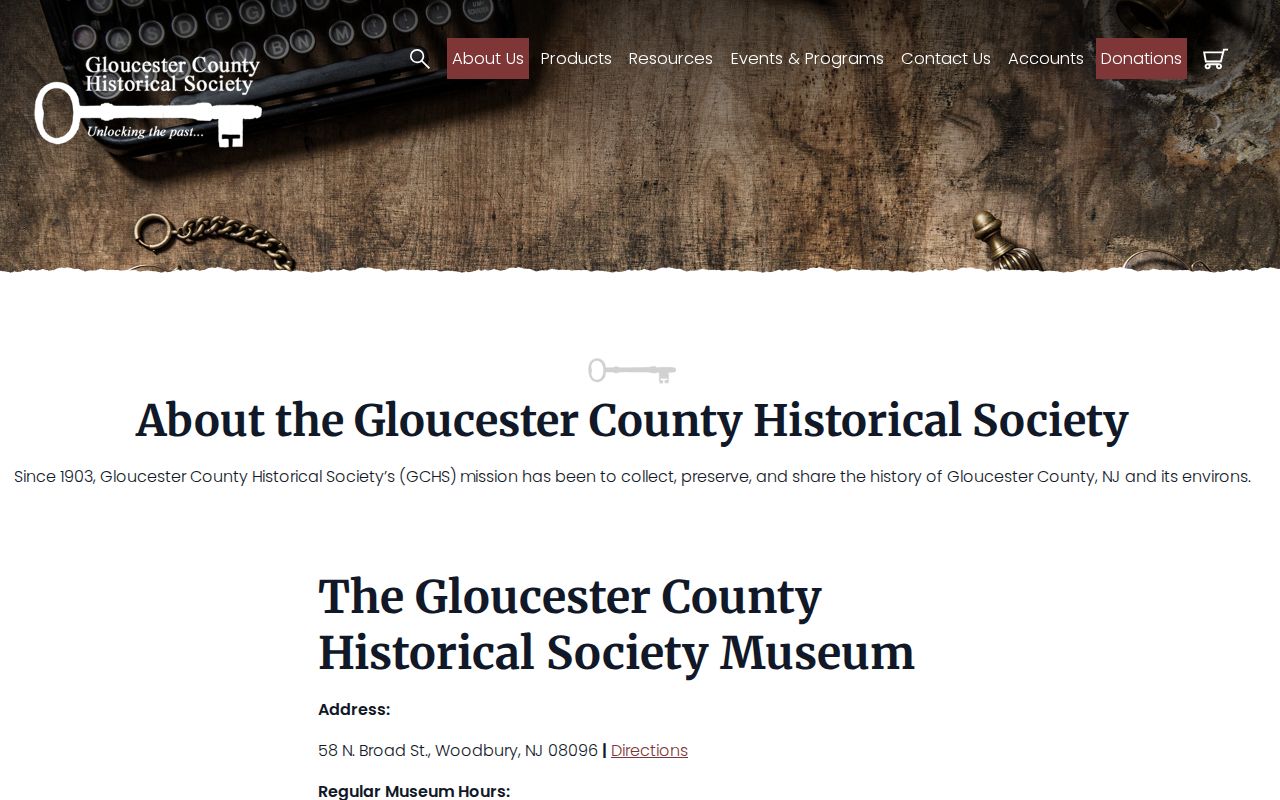
A library listing establishes that a collection exists; it does not confirm a particular surname, page, or address. Ask for the exact title, date span, and reel or volume number, then preserve those details with any note taken from the volume.
Which Gloucester County City Directory?
Gloucester is a local name trap. Gloucester City and Gloucester Township are in Camden County, not Gloucester County, and historic titles may join Salem and Gloucester material in the same volume. Older county boundaries also differed from modern ones. Before opening a Gloucester County city directory, write down the county, municipality, postal label, and year attached to the person or address. That small step avoids attaching a Camden County entry to a Gloucester County household.
This is especially important with the 1940 Polk and 1951-52 Clark directories of Gloucester City. Both provide useful examples of street-address arrangement, and Clark describes an occupation field, but they are neighboring-county context rather than Gloucester County resident evidence. The directory title, not a familiar place name alone, controls the geography of the result.
Gloucester County Directory Editions
The known sequence begins with the 1875 Salem and Gloucester Directory, which names inhabitants in places including Woodbury and Swedesboro and includes a business directory. Boyd's editions then cover 1897-98, 1899-1900, 1901-02, and 1903-04, with Woodbury included in the listed coverage. The 1913 Farm Journal Directory of Gloucester County, NJ supplies a county-level edition. Treat each as a separate record set because town coverage and arrangement can change from one publisher or year to the next.
| 1875 | Salem and Gloucester Directory, with GCHS Reel 45 identified in the research. |
|---|---|
| 1897-1904 | Four known Boyd's editions, held across the identified GCHS Salem Segment III and IV reels. |
| 1913 | Farm Journal Directory of Gloucester County, NJ, a county-directory lead to verify in the catalog. |
| Later holdings | Selected local city and telephone directories from the 1920s through the 1950s, with titles and years varying by repository. |
Note: A printed year tells when an edition was issued, not the exact day a household moved, changed a name, or left Gloucester County.
Reading a Gloucester County City Directory Entry
An entry should be copied as evidence, not paraphrased from memory. The research supports a conservative inventory: a street or address heading can lead to the resident or household entry, and the Clark example adds an occupation field. Preserve what is actually printed, including a business listing or notation. Do not supply a spouse, owner mark, or abbreviation meaning that does not appear in that edition's front matter or on its page.
| Name as printed | Keep initials, spelling, punctuation, and any suffix exactly as the volume uses them. |
|---|---|
| Street and number | Copy the heading and house number, noting a unit, rural route, or missing number. |
| Occupation or business | Record it only when printed, along with the stated business name or location. |
| Edition citation | Capture title, publisher, year, page or reel, and the town or county scope. |
| Notation | Copy any abbreviation, apartment treatment, boarder mark, or other symbol before interpreting it. |
- Criss-cross directory
- An address-ordered section that lets a researcher begin with a street and then identify the listings under that address.
- Householder index
- A name-focused arrangement that points from a person or household name to the entry supplied by that edition.
- Abbreviation key
- The explanation, usually in the volume's front matter, for the shortened labels used by that specific publisher.
Read the abbreviation key from the same volume, not from a directory published for another place. A mark that appears familiar can have a different local use, and the research did not preserve a text-accessible Gloucester page image that would support filling in an unstated meaning.
Gloucester County City Directories by Address
For an address-first question, choose the correct edition and open its street section before searching a modern name. Record every listing under the house number, then check the name section and any business directory for the same spelling. This reverse method is better suited to historical presence than to present occupancy. A blank address may mean a changed street number, a rural route, an unlisted telephone number, or simply a coverage gap.
When the address is difficult to place, compare the volume with the GCHS atlas and map holdings list. The list includes the 1876 Everts & Stewart atlas, later street maps, and county-engineer surveys. A map can help translate an older road or tract into a later street reference, but it is not a substitute for a deed or a legal boundary record.
Gloucester County Maps and Historical Directories
The 1876 Everts & Stewart Atlas of Salem & Gloucester Counties is a strong companion to a Gloucester County historical volume because it shows property owners and sketches. GCHS also describes private surveys with adjacent properties, waterways, schools, churches, landmarks, building footprints, and Every-Name and Place indexes. These items can bridge an older tract name to a later address trail, particularly where a modern street number did not yet exist.
Use a map year as a checkpoint. An owner label on an atlas is historical context, not proof of a complete ownership chain or a current relationship. Where the trail reaches handwritten deeds, road surveys, or court-related material, the County Historical Records route and the proper repository can identify a series that is not online.
Trace Households in Gloucester County City Directories
Following a household works best as a dated sequence. Start with an entry that gives both a name and a place, retain the printed spelling, and search the next known edition rather than assuming that every year exists. Pair the edition year with a census year when the timeline needs a household-level check. If an address changes, test the old and new street forms before deciding that the family left the area.
- Find the earliest confirmed name-and-place entry and copy its full citation.
- Check the next available Gloucester County edition, noting spelling, address, and printed activity.
- Use the address or criss-cross section to identify other listings at the same location in that edition.
- Pair the directory date with the relevant census source and keep conflicting details separate for later review.
- Use a dated obituary, cemetery record, estate file, or newspaper clipping only as a new lead to verify.
A disappearance has several possible explanations: a move, a death, an unlisted household, a renamed street, a changed county, or a missing run. The GCHS database includes indexed death notices and marriages from selected local newspapers through 1939, with additional marriage coverage through 1999, but an index miss does not prove that no notice existed.
Dated Directory Evidence in Gloucester County
A directory is historical evidence, not a current-residence claim. Its most useful purpose is to document what the publisher placed in a dated edition, then compare that entry with independently held records. The Society's local newspapers, maps, cemetery material, family files, and historical deposit can supply a next source, while the State Archives or County Record Room may hold the original series. Keep the source URL, repository, date, town, page or reel, and any restriction with each finding.
New Jersey privacy protections still matter when historic work reaches living people or protected records. A lawful record can be redacted, restricted, or absent from an image. Preserve the research trail without republishing protected addresses, confidential details, or information that could be used to harass someone.